The idea
Astronomy is one of the few interests I have that has nothing to do with a deadline — I fell into it purely out of curiosity, and I wanted a mobile app that matched how I actually explore it: start with something visually interesting (NASA’s Astronomy Picture of the Day), then let me check whether tonight is actually worth going outside for, then give me a live sky map and somewhere to record what I saw.
That became the shape of the app: a home feed, real observing conditions for my exact location, an embedded sky map, and a journal — four things that don’t normally live in one place.
Architecture
Built with .NET MAUI in an MVVM structure — a pattern I taught myself from documentation before it was covered in class, along with how to call external APIs from C#, ahead of the module reaching that point.
- Content — NASA’s APOD API for the daily picture and description, refreshed each day.
- Conditions — device GPS combined with the 7Timer weather API to score tonight’s visibility (cloud cover, seeing, transparency) specifically for my location, not a generic forecast.
- Sky view — Stellarium Web embedded via a WebView, so the live sky map didn’t need to be built from scratch.
- Journal — a local SQLite database storing constellation data and my own logged observations, with full CRUD.
In action
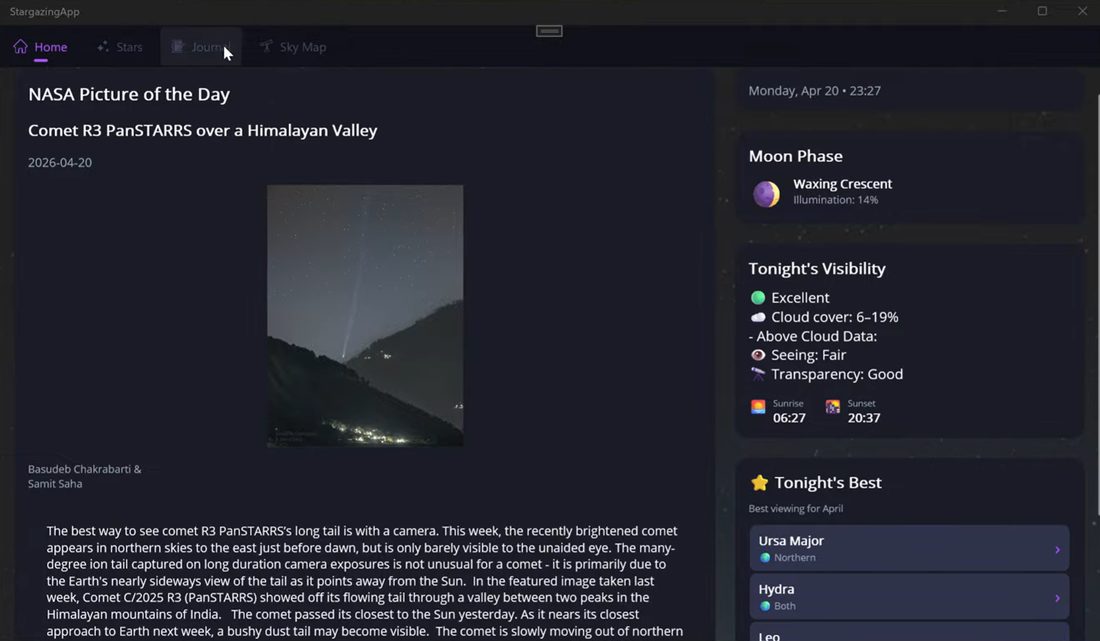 The home screen: NASA’s picture of the day, tonight’s moon phase and illumination, a visibility score built from live cloud/seeing/transparency data, and a “tonight’s best” constellation pick for the current date and hemisphere.
What I’m proud of
This is the project I talk about with the least prompting. I designed it, built it, and worked out the MVVM structure and the API layer on my own, ahead of my teacher introducing either — and I put a genuine amount of research into it beyond the code. I went in assuming there were thousands of constellations; there are officially around 80. I assumed moon-phase tracking would need some kind of external astronomical service; it turns out it’s a fairly simple date-based calculation once you know the formula, same with sunrise and sunset. Building this taught me as much about astronomy as it did about MAUI.